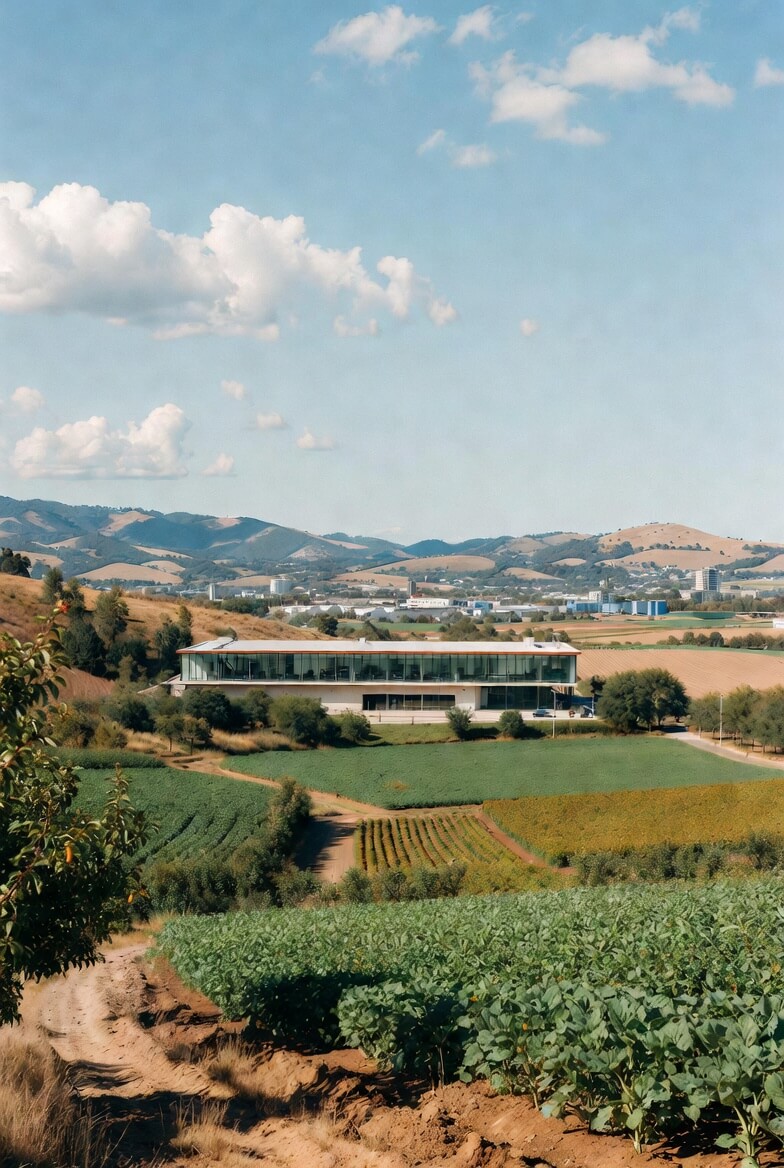
For some time now, a silent yet relentless phenomenon — visible to everyone — has been transforming the way we live: the Western food system has stopped truly nourishing us. Supply chains grow longer, producers grow more distant, territories become mere backdrops. Food continues to circulate, of course, but it has lost its voice and its story — it has lost responsibility.
What happens then? A gap opens up between those who produce and those who consume, between economy and society, between territories and markets. And it is precisely in this empty space that the Food Hub is born. A trend? A slogan? Certainly not. Rather, a structured response to an increasingly urgent question: how can we produce, distribute, and consume food without impoverishing what sustains us?
A Food Hub does not arise by chance
A Food Hub is not just a physical place. It is an architecture of relationships. It is a conscious attempt to bring order back into a supply chain that, in recent decades, has become opaque, unbalanced, and often unfair. The principles that inspire it are not neutral, nor purely economic. They are, first and foremost, value-based.
Because at the foundation of every Food Hub lies the idea that food is not a commodity like any other. Behind food there is an entire world: labor, landscape, culture, health, identity. Treating it only as a product reduces its meaning and multiplies its hidden costs — environmental, social, and territorial. For this reason, the Food Hub is created with a clear vocation: to rebuild connections. Between small producers and markets. Between rural areas and urban contexts. Between those who cultivate the land and those who live in cities. It is an infrastructure that holds together economy and responsibility, efficiency and justice.
Social utility: feeding is not enough — inclusion is necessary
The first foundational value of a Food Hub is social utility. But not in a vague, reassuring sense. Here utility is concrete, measurable, everyday.
A Food Hub matters because it guarantees market access for small and medium producers who could not manage it alone. It also creates local job opportunities, often in marginal areas. A Food Hub strengthens territorial food security by promoting food education, awareness, and participation.
In this model, value is not concentrated downstream but distributed along the supply chain. The producer is not the weak link but a central actor. The consumer is not just a customer but part of a system capable of choice. The social utility of the Food Hub lies precisely here: transforming food into a tool of cohesion rather than exclusion. Demonstrating that a fairer food economy is not a utopia, but a feasible construction.
Efficiency: doing better, not simply more
A widespread misunderstanding accompanies every discussion about sustainability: the idea that it is inefficient, unrealistic, incapable of reaching its stated goals. The Food Hub overturns this narrative. It does not reduce efficiency — it redefines it. How? Not by maximizing volumes, but by optimizing resources. This essentially means four actions: reducing unnecessary intermediaries; shortening physical and decision-making distances; sharing logistical, digital, and organizational infrastructures; and coordinating supply and demand intelligently.
In this sense, the Food Hub is a direct response to the systemic waste of the global food system — waste of food, energy, labor, and knowledge. Networking what was previously fragmented means building a system, not losing competitiveness. On the contrary, it means building a more solid competitiveness, less vulnerable to crises and more rooted in territories. An efficiency that does not consume natural and human capital, but preserves it.
Social ethics: choosing which side to stand on
The third value that inspires the Food Hub system is social ethics. Every Food Hub is, inevitably, a political choice in the highest sense of the term — not because it takes an ideological stance, but because it cannot be neutral. It decides what to value, whom to include, which practices to support.
Social ethics comes into play when clear criteria are established:
In a Food Hub, these are not abstract statements. They become operational rules, access parameters, and collaboration conditions. Ethics is not decoration — it is a load-bearing structure. This radically distinguishes the Food Hub from dominant supply-chain models: it does not chase the lowest price at any cost. It rejects and will ALWAYS reject the Race to the Bottom. It consciously chooses a different path, where sustainability is not a compromise but a direction.
Equity between those here today and those who will come tomorrow
A Food Hub, if it truly wants to be sustainable, cannot stop at the present. Every choice it makes — from how it remunerates producers to how it manages natural resources, to which supply chains it supports — has effects that extend across time and people.
Two dimensions are at stake: intra-generational and inter-generational equity — often ignored, yet decisive. Intra-generational equity concerns the here and now: ensuring fair conditions along the entire supply chain, reducing inequalities, preventing value from concentrating in only a few links while others remain vulnerable. Inter-generational equity, instead, calls for responsibility toward those who come after us: not consuming today the natural, social, and economic capital needed tomorrow. The Food Hub stands precisely in this ethical space, where food becomes a choice of justice in the present and a promise of possibility for the future — showing that feeding a community means caring for its time, not only its immediate needs.
Sustainability as a process, not a label
Emphasizing sustainability in a Food Hub does not mean applying a green sticker. It means building a continuous process made of daily decisions, monitoring, and adaptation. Sustainability emerges when natural capital is respected and regenerated, when human capital is trained and valued, when social capital is strengthened through trust and cooperation, and when economic capital is reinvested in the territory. It is a sustainability that holds present and future together, that looks to the generations to come, that recognizes every food choice as also a territorial choice.
An infrastructure for the future of territories
In the end, the Food Hub is not only about food. It is about a development model. It is a practical laboratory for moving beyond extractive logics and building resilient systems. As discussed in the article on territories previously featured in this blog, the message here too is clear: there is no more time to postpone. The food system is one of the fields where the contradictions of our time are most visible — but also one where change is most possible.
Of course, the Food Hub system does not promise easy solutions. It promises work, coordination, responsibility. But it offers something precious: the possibility of placing food back at the center of a shared vision, where social utility, efficiency, and social ethics are not just words, but daily practices. And perhaps it is precisely from here — from what we eat and how we choose to produce it — that a new idea of territory can begin again.
What happens then? A gap opens up between those who produce and those who consume, between economy and society, between territories and markets. And it is precisely in this empty space that the Food Hub is born. A trend? A slogan? Certainly not. Rather, a structured response to an increasingly urgent question: how can we produce, distribute, and consume food without impoverishing what sustains us?
A Food Hub does not arise by chance
A Food Hub is not just a physical place. It is an architecture of relationships. It is a conscious attempt to bring order back into a supply chain that, in recent decades, has become opaque, unbalanced, and often unfair. The principles that inspire it are not neutral, nor purely economic. They are, first and foremost, value-based.
Because at the foundation of every Food Hub lies the idea that food is not a commodity like any other. Behind food there is an entire world: labor, landscape, culture, health, identity. Treating it only as a product reduces its meaning and multiplies its hidden costs — environmental, social, and territorial. For this reason, the Food Hub is created with a clear vocation: to rebuild connections. Between small producers and markets. Between rural areas and urban contexts. Between those who cultivate the land and those who live in cities. It is an infrastructure that holds together economy and responsibility, efficiency and justice.
Social utility: feeding is not enough — inclusion is necessary
The first foundational value of a Food Hub is social utility. But not in a vague, reassuring sense. Here utility is concrete, measurable, everyday.
A Food Hub matters because it guarantees market access for small and medium producers who could not manage it alone. It also creates local job opportunities, often in marginal areas. A Food Hub strengthens territorial food security by promoting food education, awareness, and participation.
In this model, value is not concentrated downstream but distributed along the supply chain. The producer is not the weak link but a central actor. The consumer is not just a customer but part of a system capable of choice. The social utility of the Food Hub lies precisely here: transforming food into a tool of cohesion rather than exclusion. Demonstrating that a fairer food economy is not a utopia, but a feasible construction.
Efficiency: doing better, not simply more
A widespread misunderstanding accompanies every discussion about sustainability: the idea that it is inefficient, unrealistic, incapable of reaching its stated goals. The Food Hub overturns this narrative. It does not reduce efficiency — it redefines it. How? Not by maximizing volumes, but by optimizing resources. This essentially means four actions: reducing unnecessary intermediaries; shortening physical and decision-making distances; sharing logistical, digital, and organizational infrastructures; and coordinating supply and demand intelligently.
In this sense, the Food Hub is a direct response to the systemic waste of the global food system — waste of food, energy, labor, and knowledge. Networking what was previously fragmented means building a system, not losing competitiveness. On the contrary, it means building a more solid competitiveness, less vulnerable to crises and more rooted in territories. An efficiency that does not consume natural and human capital, but preserves it.
Social ethics: choosing which side to stand on
The third value that inspires the Food Hub system is social ethics. Every Food Hub is, inevitably, a political choice in the highest sense of the term — not because it takes an ideological stance, but because it cannot be neutral. It decides what to value, whom to include, which practices to support.
Social ethics comes into play when clear criteria are established:
- Respect for labor and rights;
- Attention to environmental impact;
- Transparency in relationships;
- Fairness in value distribution
In a Food Hub, these are not abstract statements. They become operational rules, access parameters, and collaboration conditions. Ethics is not decoration — it is a load-bearing structure. This radically distinguishes the Food Hub from dominant supply-chain models: it does not chase the lowest price at any cost. It rejects and will ALWAYS reject the Race to the Bottom. It consciously chooses a different path, where sustainability is not a compromise but a direction.
Equity between those here today and those who will come tomorrow
A Food Hub, if it truly wants to be sustainable, cannot stop at the present. Every choice it makes — from how it remunerates producers to how it manages natural resources, to which supply chains it supports — has effects that extend across time and people.
Two dimensions are at stake: intra-generational and inter-generational equity — often ignored, yet decisive. Intra-generational equity concerns the here and now: ensuring fair conditions along the entire supply chain, reducing inequalities, preventing value from concentrating in only a few links while others remain vulnerable. Inter-generational equity, instead, calls for responsibility toward those who come after us: not consuming today the natural, social, and economic capital needed tomorrow. The Food Hub stands precisely in this ethical space, where food becomes a choice of justice in the present and a promise of possibility for the future — showing that feeding a community means caring for its time, not only its immediate needs.
Sustainability as a process, not a label
Emphasizing sustainability in a Food Hub does not mean applying a green sticker. It means building a continuous process made of daily decisions, monitoring, and adaptation. Sustainability emerges when natural capital is respected and regenerated, when human capital is trained and valued, when social capital is strengthened through trust and cooperation, and when economic capital is reinvested in the territory. It is a sustainability that holds present and future together, that looks to the generations to come, that recognizes every food choice as also a territorial choice.
An infrastructure for the future of territories
In the end, the Food Hub is not only about food. It is about a development model. It is a practical laboratory for moving beyond extractive logics and building resilient systems. As discussed in the article on territories previously featured in this blog, the message here too is clear: there is no more time to postpone. The food system is one of the fields where the contradictions of our time are most visible — but also one where change is most possible.
Of course, the Food Hub system does not promise easy solutions. It promises work, coordination, responsibility. But it offers something precious: the possibility of placing food back at the center of a shared vision, where social utility, efficiency, and social ethics are not just words, but daily practices. And perhaps it is precisely from here — from what we eat and how we choose to produce it — that a new idea of territory can begin again.
There is a moment in the life of territories when something stops working without making noise. Houses don’t collapse, factories don’t stop, people don’t disappear. And yet, slowly, the meaning of things thins out. Cities become interchangeable, economies fragile, landscapes exhausted. It is from this silence that the authors’ work begins: not from a sudden crisis, but from a continuous, systemic, almost normalized erosion.
The article speaks of numbers, models, capital stocks. But beneath the methodological surface there is a precise story: that of a world that chose to run without asking where it was going, and of territories that, in trying to remain competitive, began to lose themselves.
The race that lowers everything
They call it the Race to the Bottom. It is a technical expression, but it sounds like the title of a dystopian novel. A race in which you win by lowering prices, compressing rights, simplifying complexity, externalizing everything that weighs on the system. In this race there is no real finish line, only a continuous lowering of the bar: fewer protections, less quality, less future.
Scientists explain it precisely: production standardization, outsourcing of economic, social and environmental costs, competition based almost exclusively on price. But if you read between the lines, what emerges is an impoverished human landscape. A system that produces increasingly similar goods and increasingly fragile territories, as if diversity were a flaw to be corrected rather than a richness to be protected.
In this race, some territories seem to gain ground for a while. But it is a fragile, temporary advantage. Because while they run, they consume the resources that make the race itself possible.
The capitals that make no noise while being consumed
One of the most powerful aspects of the article is the way it speaks about the four capitals: natural, human, social and economic. They are called “stocks,” analyzed and measured. But in reality, what is being described is something much deeper: the invisible wealth that allows societies to exist.
Natural capital is not just the environment: it is the possibility to breathe, cultivate, inhabit. Human capital is not just skills: it is knowledge, education, the ability to imagine. Social capital is not just networks: it is trust, cohesion, a sense of belonging. Economic capital, finally, is not just wealth: it is stability, investment capacity, vision.
The Race to the Bottom consumes them all, but it does so slowly, without noise. And precisely for this reason it is dangerous. Because when we notice it, the damage is already structural. Territories become dependent on models that impoverish them, while well-being stops being shared and becomes unequal, fragmented, unstable.
Well-being that does not hold over time
The authors insist on a key expression: socially shared well-being. This is not a semantic detail. It is an ethical position. Because well-being that grows only for some, or only for a limited period, is not sustainable. It is a broken promise.
The empirical evidence cited in the study is harsh: growing inequalities, loss of biodiversity, insufficient investment in the future, rising public debt, weak territorial resilience. But the point is not the list — it is the trajectory. A world that consumes today what it will not be able to restore tomorrow.
Then there is the dimension of time, seen as a moral dimension. The article clearly speaks about intergenerational equity: what we do today falls on those who come after us. Every short-term choice is a problematic inheritance. Every externalized cost is a deferred bill.
The false alternative between growth and sustainability
One of the most important passages in the work is the rejection of a toxic narrative: the one that sets growth and sustainability against each other as if they were enemies. The authors dismantle this dichotomy rigorously, but also with a clarity that carries political weight.
Sustainability does not block growth. It is short-sighted growth that destroys the conditions for sustainability. The problem is not competing, but competing badly. Not producing, but producing without asking for whom, at what price, and with what consequences.
From here comes the proposal for a new competitive paradigm, based on social utility, efficiency and social ethics. Concepts that may sound abstract, but actually speak to everyday choices: what we incentivize, what we reward, what we consider acceptable.
Territories as protagonists, not extras
In the narrative that emerges from the article, territories are not mere pawns of globalization. They are places of decision. They can choose whether to continue chasing models that consume them or to build different trajectories — perhaps slower, but more solid.
This requires awareness, literacy and shared responsibility. Businesses, families, institutions, the research world, the non-profit sector: no one is neutral. Everyone participates, for better or worse, in the direction taken.
Hence the call to action. No shortcuts are proposed, but rather work, coordination and vision. Innovation — not as a technological fetish, but as social transformation.
There is no more time to pretend
The message is essentially one: the Race to the Bottom is not sustainable. Not economically, not socially, not humanly.
Continuing along this path means accepting a future of weaker territories, more unequal societies, more frequent conflicts. Exiting it means rethinking the rules of the game, putting shared well-being back at the center, recognizing that sustainability is not a luxury but a necessity.
Read this way, the work of Cesaretti and the other authors is not only a scientific contribution. It is a warning — and at the same time, an act of trust: the idea that territories can still choose not to lose their voice.
The article speaks of numbers, models, capital stocks. But beneath the methodological surface there is a precise story: that of a world that chose to run without asking where it was going, and of territories that, in trying to remain competitive, began to lose themselves.
The race that lowers everything
They call it the Race to the Bottom. It is a technical expression, but it sounds like the title of a dystopian novel. A race in which you win by lowering prices, compressing rights, simplifying complexity, externalizing everything that weighs on the system. In this race there is no real finish line, only a continuous lowering of the bar: fewer protections, less quality, less future.
Scientists explain it precisely: production standardization, outsourcing of economic, social and environmental costs, competition based almost exclusively on price. But if you read between the lines, what emerges is an impoverished human landscape. A system that produces increasingly similar goods and increasingly fragile territories, as if diversity were a flaw to be corrected rather than a richness to be protected.
In this race, some territories seem to gain ground for a while. But it is a fragile, temporary advantage. Because while they run, they consume the resources that make the race itself possible.
The capitals that make no noise while being consumed
One of the most powerful aspects of the article is the way it speaks about the four capitals: natural, human, social and economic. They are called “stocks,” analyzed and measured. But in reality, what is being described is something much deeper: the invisible wealth that allows societies to exist.
Natural capital is not just the environment: it is the possibility to breathe, cultivate, inhabit. Human capital is not just skills: it is knowledge, education, the ability to imagine. Social capital is not just networks: it is trust, cohesion, a sense of belonging. Economic capital, finally, is not just wealth: it is stability, investment capacity, vision.
The Race to the Bottom consumes them all, but it does so slowly, without noise. And precisely for this reason it is dangerous. Because when we notice it, the damage is already structural. Territories become dependent on models that impoverish them, while well-being stops being shared and becomes unequal, fragmented, unstable.
Well-being that does not hold over time
The authors insist on a key expression: socially shared well-being. This is not a semantic detail. It is an ethical position. Because well-being that grows only for some, or only for a limited period, is not sustainable. It is a broken promise.
The empirical evidence cited in the study is harsh: growing inequalities, loss of biodiversity, insufficient investment in the future, rising public debt, weak territorial resilience. But the point is not the list — it is the trajectory. A world that consumes today what it will not be able to restore tomorrow.
Then there is the dimension of time, seen as a moral dimension. The article clearly speaks about intergenerational equity: what we do today falls on those who come after us. Every short-term choice is a problematic inheritance. Every externalized cost is a deferred bill.
The false alternative between growth and sustainability
One of the most important passages in the work is the rejection of a toxic narrative: the one that sets growth and sustainability against each other as if they were enemies. The authors dismantle this dichotomy rigorously, but also with a clarity that carries political weight.
Sustainability does not block growth. It is short-sighted growth that destroys the conditions for sustainability. The problem is not competing, but competing badly. Not producing, but producing without asking for whom, at what price, and with what consequences.
From here comes the proposal for a new competitive paradigm, based on social utility, efficiency and social ethics. Concepts that may sound abstract, but actually speak to everyday choices: what we incentivize, what we reward, what we consider acceptable.
Territories as protagonists, not extras
In the narrative that emerges from the article, territories are not mere pawns of globalization. They are places of decision. They can choose whether to continue chasing models that consume them or to build different trajectories — perhaps slower, but more solid.
This requires awareness, literacy and shared responsibility. Businesses, families, institutions, the research world, the non-profit sector: no one is neutral. Everyone participates, for better or worse, in the direction taken.
Hence the call to action. No shortcuts are proposed, but rather work, coordination and vision. Innovation — not as a technological fetish, but as social transformation.
There is no more time to pretend
The message is essentially one: the Race to the Bottom is not sustainable. Not economically, not socially, not humanly.
Continuing along this path means accepting a future of weaker territories, more unequal societies, more frequent conflicts. Exiting it means rethinking the rules of the game, putting shared well-being back at the center, recognizing that sustainability is not a luxury but a necessity.
Read this way, the work of Cesaretti and the other authors is not only a scientific contribution. It is a warning — and at the same time, an act of trust: the idea that territories can still choose not to lose their voice.